
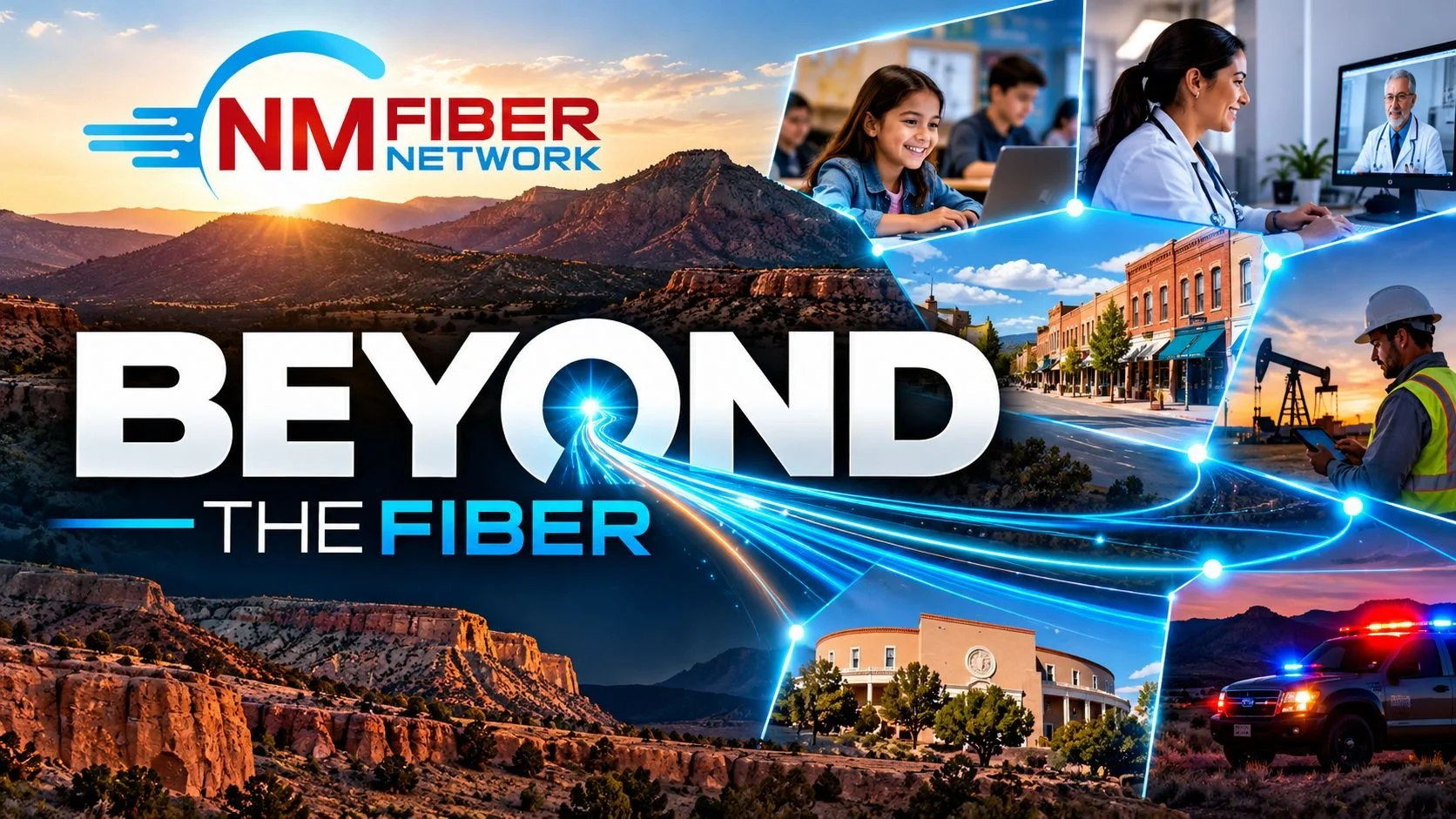
Beyond the Fiber
What Happens After a Community Gets Connected?
The Construction May Be Complete, But the Real Opportunity Is Just Beginning.
When a community gains access to new fiber infrastructure, it's an important milestone. Months or even years of planning, engineering, permitting, construction, and investment have finally resulted in something tangible: a network capable of delivering high-capacity connectivity.
It's a moment worth celebrating.
But there's an important question that often gets overlooked in the excitement of completing a broadband project.
What happens next?
Because the true value of connectivity isn't measured simply by the miles of fiber installed, the number of locations reached, or the capacity of the network.
It's measured by what people, businesses, and institutions can accomplish because that infrastructure exists.
At New Mexico Fiber Network, we believe the conversation about broadband shouldn't end when construction is complete.
In many ways, that's when the most important conversation begins.
From Infrastructure to Opportunity
Building fiber infrastructure creates the foundation for digital opportunity. But infrastructure alone doesn't guarantee that every household, business, or organization will immediately benefit.
That requires adoption.
For communities, broadband adoption means helping residents, businesses, schools, healthcare providers, and public institutions understand how connectivity can improve their daily activities and long-term capabilities.
It also means addressing barriers such as affordability, access to devices, digital literacy, and awareness of available services.
A network may be capable of delivering exceptional performance, but its full potential remains unrealized if the people and organizations it can serve aren't equipped to use it.
That's why successful broadband initiatives must consider not only where networks are built, but how those networks will be used.
The goal isn't simply to make connectivity available. It's to make connectivity meaningful.
Building a Workforce for a Connected Economy
One of the most significant opportunities created by improved connectivity is workforce development.
Today's employers increasingly depend on digital tools, cloud-based applications, remote collaboration, automated systems, and access to specialized training.
For communities across New Mexico, improved broadband infrastructure can help expand access to educational resources, online certification programs, technical training, and workforce-development initiatives.
Students may gain greater access to digital learning opportunities. Working adults may pursue additional credentials without relocating. Employers may connect employees with specialized training resources that previously required significant travel.
And for communities working to attract new industries, a digitally capable workforce can become an important competitive advantage.
Connectivity doesn't replace the need for strong educational institutions or effective workforce programs.
But it can give those organizations additional tools to prepare people for the jobs of today and tomorrow.
Helping Local Businesses Think Bigger
For small businesses, improved connectivity can create opportunities that extend well beyond the local marketplace.
Consider a manufacturer adopting connected equipment to improve production efficiency. A retailer expanding into e-commerce. An agricultural operation using data-driven technology to manage resources. Or a professional services company serving customers across multiple states.
Each example demonstrates how reliable digital infrastructure can support new ways of doing business.
For existing employers, better connectivity can support operational efficiency, cloud adoption, customer service, and future expansion.
For entrepreneurs, it can reduce some of the geographic barriers associated with launching and growing a business.
And for economic-development organizations, access to scalable communications infrastructure can become another important asset when promoting their communities to prospective employers.
A connected community has more than access to the digital economy. It has an opportunity to participate more fully in it.
Expanding Access to Essential Digital Services
The benefits of connectivity extend beyond economic development.
Healthcare organizations increasingly rely on digital systems for patient records, telehealth, imaging, and communication between facilities.
Schools and libraries use connected technologies to expand educational opportunities and provide access to information.
Government agencies depend on reliable networks to deliver public services, manage operations, and communicate with residents.
Public safety organizations require dependable communications to coordinate resources and support emergency response.
For rural and geographically dispersed communities, access to these digital services can be particularly important.
New connectivity options can help institutions expand their capabilities and improve how they serve the public.
However, those benefits depend on more than bandwidth alone. Organizations also need the appropriate equipment, applications, cybersecurity practices, trained personnel, and operational resources.
Fiber infrastructure provides the foundation. The services built upon it create the impact.
Why the Middle Mile Still Matters After Construction
Much of the public attention surrounding broadband expansion focuses on connecting homes and businesses through last-mile networks.
But long-term success also depends on the infrastructure supporting those connections.
Middle-mile networks connect local providers and institutions to larger regional and national communications resources.
As broadband adoption increases, so does demand for capacity.
Businesses expand their use of cloud services. Schools introduce new learning technologies. Healthcare providers adopt more data-intensive applications. Residents rely on increasingly sophisticated digital services.
That growing demand requires scalable, resilient network infrastructure.
New Mexico Fiber Network is helping strengthen that foundation through a statewide middle-mile network designed to support high-capacity connectivity, network diversity, and access to broader communications resources.
By connecting local networks to regional and national infrastructure, NM Fiber Network helps create the conditions for service providers and institutions to meet evolving connectivity needs.
And through a carrier-neutral approach, the network supports opportunities for multiple providers to expand services and reach additional communities.
The importance of that infrastructure doesn't disappear once construction crews leave.
In fact, it becomes even more important as communities begin taking full advantage of their new connectivity.
Measuring Success Beyond Miles of Fiber
If communities want to understand the long-term value of broadband investment, they need to look beyond traditional construction metrics.
Miles of fiber installed, locations passed, and network capacity are important measures of infrastructure development.
But they don't tell the entire story.
Communities should also consider questions such as:
Are more households and businesses adopting available broadband services?
Are local employers using connectivity to improve operations or expand into new markets?
Are schools, libraries, and workforce organizations offering additional digital learning opportunities?
Are healthcare providers and public institutions expanding access to digital services?
Is the community better positioned to attract investment, support entrepreneurship, and retain talent?
These questions shift the focus from infrastructure deployment to community outcomes.
And those outcomes are where the long-term value of connectivity becomes most visible.
The Real Return on Connectivity
A fiber network can be completed on a construction schedule.
But the economic and community benefits it enables can develop over years and decades.
A student who gains access to advanced coursework today may become part of tomorrow's skilled workforce.
A small business that begins selling online may eventually reach customers across the country.
A healthcare organization that expands digital services may improve access to care for patients across a broader geographic area.
And a community that invests in digital infrastructure today may be better prepared to compete for opportunities that don't yet exist.
None of these outcomes happens automatically.
They require collaboration among service providers, businesses, educators, healthcare organizations, government leaders, and community stakeholders.
But they all begin with the same essential foundation: access to reliable, scalable connectivity.
At New Mexico Fiber Network, we're committed to helping build the infrastructure that makes those opportunities possible.
Because the ultimate goal isn't simply to connect communities.
It's to help create communities where people can learn more, businesses can grow stronger, institutions can serve better, and future generations have greater opportunities to succeed.
The fiber may be in the ground.
But the real possibilities are just beginning.
That's Beyond the Fiber.
