
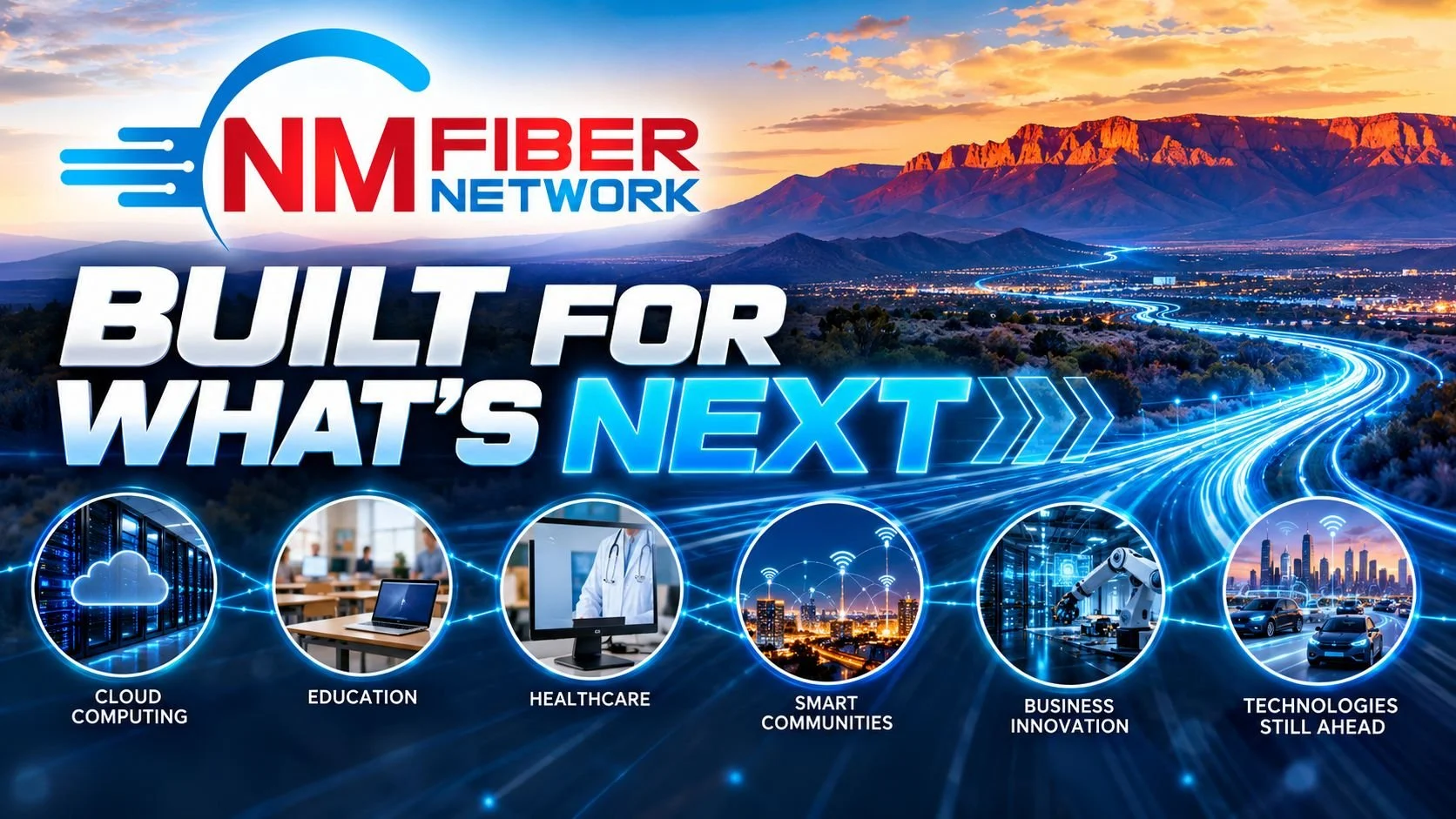
BUILT FOR WHAT’S NEXT
From 100G to 400G and Beyond
How much network capacity will New Mexico need five years from now?
Ten years from now?
What about twenty?
No one can predict those numbers with absolute certainty. But network planners don't need a crystal ball to know one thing:
Demand will continue to grow.
More connected devices. More cloud applications. More video. More telehealth. More data-intensive business operations. More artificial intelligence. More connected infrastructure. More wireless traffic. And more organizations depending on broadband connectivity for everyday operations.
That's why a network shouldn't be designed only around the capacity customers need today.
It should be built for what's next.
100G Is a Milestone, not a Finish Line
NM Fiber Network's 100-gigabit backbone provides significant capacity for moving data across the network and supporting connectivity throughout New Mexico.
But good network strategy doesn't stop with asking, “How much capacity do we have?”
It also asks:
“How do we increase it when we need more?”
That's where an upgraded path becomes critical.
As traffic increases, technology evolves and customer requirements change, network infrastructure can be upgraded to support higher-capacity connections including the progression from 100G to 400G and potentially beyond.
Think of it less like constructing a road that will always have the same number of lanes and more like designing the transportation corridor so additional capacity can be added as traffic grows.
The goal isn't necessarily to build tomorrow's maximum capacity today.
The goal is to make sure tomorrow's capacity is achievable.
Why Does Network Demand Keep Growing?
Think about how dramatically connectivity has changed in just the past decade.
Organizations that once primarily depended on their internet connection for email and basic web applications may now rely on cloud-based platforms, video conferencing, cybersecurity systems, remote operations, real-time data analytics and enormous data transfers.
Healthcare providers are expanding telehealth and connected medical applications.
Schools and universities are incorporating cloud platforms, video and increasingly sophisticated digital learning tools.
Businesses are moving more applications and data into the cloud.
Public safety agencies depend on communications and data to support critical operations.
Wireless providers need fiber connectivity to support growing mobile traffic.
Data centers and technology companies can require enormous amounts of bandwidth.
And emerging applications involving artificial intelligence, automation, advanced manufacturing and connected infrastructure will continue adding new demands.
The question isn't whether network traffic will grow.
It's how networks prepare for that growth.
From 100G to 400G
The move from 100 gigabits per second to 400 gigabits per second represents a fourfold increase in potential capacity on a connection.
But increasing network capacity doesn't necessarily mean replacing every mile of fiber in the ground.
One of fiber's greatest advantages is its ability to support increasingly advanced optical technologies. With the appropriate network architecture and infrastructure in place, operators can upgrade the electronics and optical equipment that transmit data across fiber to unlock greater capacity.
That distinction is important.
The fiber itself is a long-term infrastructure investment. The technology operating across that fiber can continue evolving.
That means today's fiber network can provide the foundation for tomorrow's higher-capacity services, provided that evolution was considered when the network was designed.
The Importance of an Upgrade Path
Building a network without considering future expansion can create expensive problems later.
What happens when capacity becomes constrained?
Can equipment be upgraded?
Can additional wavelengths be introduced?
Does the underlying fiber infrastructure support future technologies?
Are facilities, power systems and network architecture prepared for higher-capacity equipment?
Can new routes or interconnection points be incorporated as the network grows?
Those aren't questions organizations should begin asking when they are already running out of capacity.
They should be part of the strategy from the beginning.
An effective upgrade path allows network operators to make investments when demand justifies them rather than attempting to predict and pay for every future requirement on day one.
Scalability Is About More Than Speed
It's easy to think of 100G and 400G simply as speed numbers.
But scalability is about much more than winning a bandwidth race.
It's about supporting economic development.
It's about giving broadband providers room to grow.
It's about enabling schools, healthcare systems, municipalities and public agencies to adopt new technologies without infrastructure becoming the limiting factor.
It's about helping businesses expand and allowing new industries to consider communities they may have previously overlooked.
And it's about making sure rural areas aren't left behind as bandwidth requirements continue increasing elsewhere.
A scalable middle-mile network creates opportunities because organizations can make technology decisions knowing the underlying infrastructure has a path to grow with them.
Building for Needs We Haven't Imagined Yet
Some of the most important applications that will use tomorrow's networks may not exist today.
Twenty years ago, few people could have predicted how dependent everyday life would become on cloud computing, streaming video, smartphones, telehealth, remote work and connected devices.
The next twenty years will bring technologies we haven't yet imagined.
That's precisely why infrastructure planning must look beyond today's requirements.
We may not know exactly what applications will drive tomorrow's traffic.
But we can build networks capable of adapting when they arrive.
At NM Fiber Network, our 100G backbone represents what the network can deliver today. Planning for 400G and future generations of technology represents something equally important:
Where the network can go tomorrow.
Because long-term infrastructure isn't about predicting the future perfectly.
It's about making sure you're ready when the future arrives.
Built for What's Next
Infrastructure designed for today. A network ready for tomorrow.
