
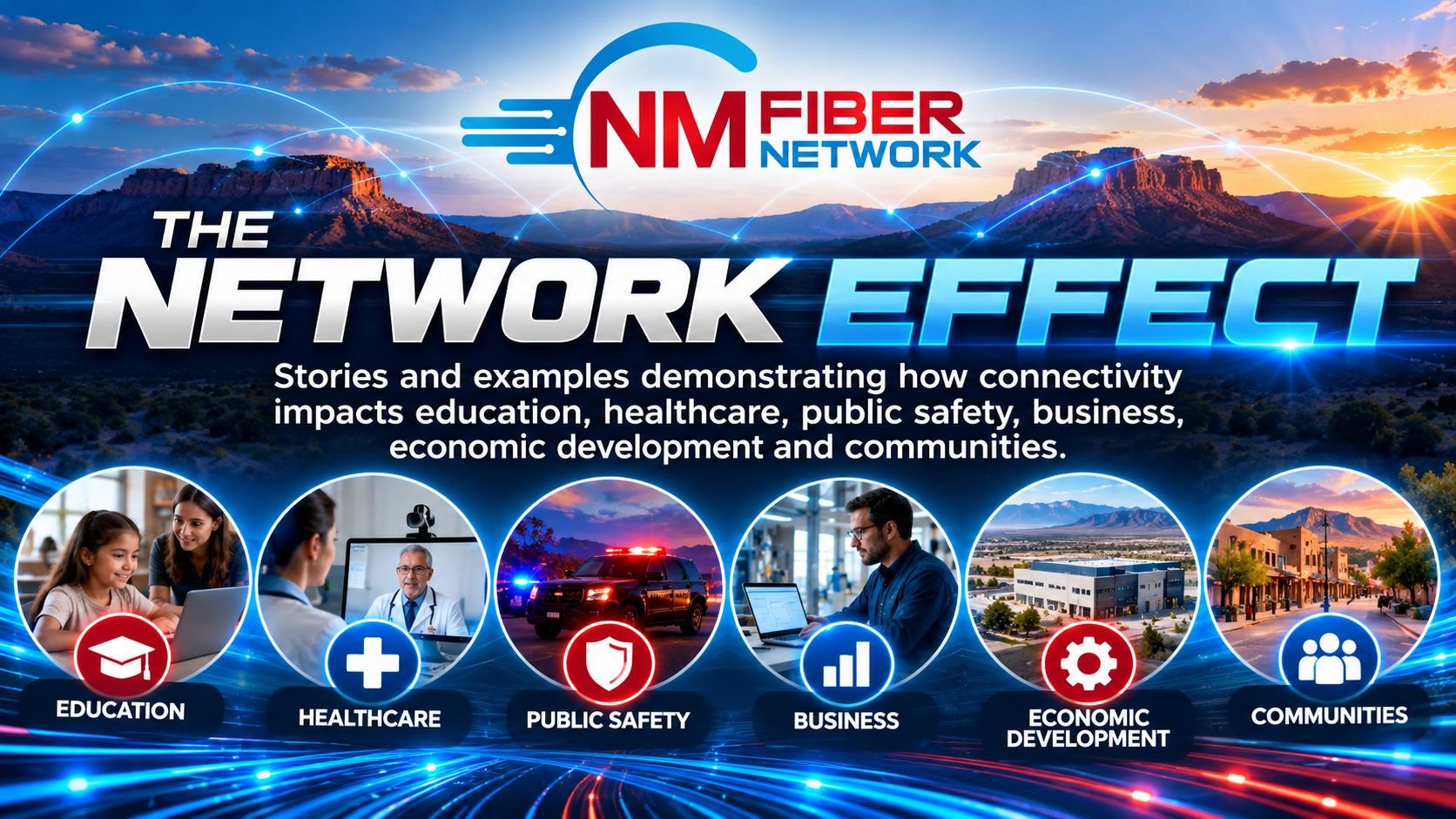
The Network Effect: The Connected Community
Why Stronger Connectivity for One Institution Can Create Opportunities for an Entire Community
When we talk about broadband infrastructure, it's easy to think about individual connections.
A school needs reliable internet. A hospital needs access to digital medical records. A business needs connectivity to reach customers. A local government needs dependable communications to deliver essential services.
Each of these needs is important on its own.
But what happens when we stop looking at these connections individually and start looking at how they work together?
We begin to see something much bigger.
A truly connected community isn't simply a collection of buildings with internet access. It's an interconnected digital ecosystem where stronger connectivity for one institution can create opportunities for everyone.
That's the power of the network effect.
Connectivity Doesn't Exist in Isolation
Consider the different institutions that make a community function.
Schools educate the next generation. Hospitals and healthcare providers protect community health. Businesses create jobs and drive economic activity. Local governments coordinate services and infrastructure. Public safety agencies respond when emergencies occur. Residents participate in all of these systems every day.
While each organization serves a different purpose, their digital needs increasingly overlap.
A school may rely on cloud-based educational platforms hosted hundreds of miles away. A hospital may exchange medical information with specialists in another city. A manufacturer may coordinate production with suppliers across the country. Emergency responders may depend on digital mapping, dispatch systems, and real-time communications.
These activities require more than isolated internet connections.
They depend on a broader network infrastructure capable of moving information reliably between organizations, service providers, and destinations.
The stronger that underlying infrastructure becomes, the more opportunities communities have to connect, collaborate, and grow.
Schools: Connecting Education to Opportunity
For students, reliable broadband can mean access to educational opportunities that extend far beyond the classroom.
Digital learning platforms, virtual instruction, online research, and specialized coursework can help schools expand the resources available to students.
But the benefits don't necessarily stop at the schoolhouse door.
When a community improves the infrastructure supporting its educational institutions, it may also create opportunities for nearby businesses, libraries, and residents to benefit from expanded network capacity or additional service options.
Students who gain access to advanced digital tools develop skills that can strengthen the local workforce.
Businesses benefit from a better-prepared talent pool.
And communities become more attractive to families looking for places where their children can learn, grow, and succeed.
An investment in educational connectivity can become an investment in a community's economic future.
Healthcare: Connecting Patients to Better Possibilities
In rural New Mexico, access to specialized healthcare can require significant travel.
Broadband connectivity helps create alternatives.
Telehealth services can connect patients with providers in distant locations. Healthcare facilities can exchange medical records, access cloud-based systems, and collaborate with specialists across regional and national networks.
Reliable, high-capacity connectivity can also support advanced diagnostic technologies and the transfer of large medical imaging files.
But healthcare connectivity has implications beyond the hospital.
When healthcare providers have the infrastructure necessary to expand digital services, residents may gain more convenient access to care. Employers benefit when workers have better access to healthcare resources. Communities become more attractive to families and businesses evaluating quality of life.
The impact extends throughout the local economy.
Better-connected healthcare institutions can help create healthier, more resilient communities.
Businesses: Turning Local Connections Into Global Opportunities
For businesses, geography doesn't have to define opportunity.
A small manufacturer in rural New Mexico may serve customers across the country. A local entrepreneur may operate an online business reaching international markets. A professional services firm may collaborate with clients hundreds of miles away.
These opportunities depend on dependable connectivity.
Cloud computing, video conferencing, e-commerce, digital payment systems, and data-intensive business applications all require reliable network performance.
When broadband infrastructure improves, local businesses may gain access to services and capabilities that were previously difficult or expensive to obtain.
And as businesses grow, they create additional opportunities for employment, investment, and economic development.
A stronger business community supports local tax revenues, strengthens demand for services, and helps sustain the institutions that make communities successful.
The value of connectivity multiplies when businesses can use it to create opportunities beyond their immediate geographic boundaries.
Local Government and Public Safety: Connecting Essential Services
Connectivity also plays a critical role in how communities operate and respond to challenges.
Local governments increasingly rely on digital platforms for permitting, utility management, public records, financial operations, and communication with residents.
Public safety agencies depend on communications infrastructure to coordinate emergency responses, access information, and support dispatch operations.
During an emergency, reliable connectivity can become especially important.
A well-designed network with appropriate redundancy and diverse routing can help reduce the impact of certain disruptions, supporting continuity for essential digital services.
And when government agencies, healthcare facilities, schools, and public safety organizations have dependable connectivity, they are better positioned to coordinate their efforts.
The result can be more efficient service delivery, stronger emergency preparedness, and improved access to public resources.
Connectivity isn't just about convenience. For many community institutions, it's part of the infrastructure that supports public well-being and safety.
Residents: Where the Network Effect Becomes Personal
Ultimately, the value of a connected community is measured by how connectivity improves everyday life.
A resident may use broadband to work remotely, complete an online degree, attend a telehealth appointment, operate a home-based business, or access government services.
Families may benefit from stronger schools, more accessible healthcare, and expanded employment opportunities.
Older residents may find it easier to connect with healthcare providers and family members.
Young professionals may discover that they can pursue careers without leaving the communities where they grew up.
These benefits are interconnected.
A community with strong educational resources, dependable healthcare, successful businesses, and effective public services becomes a more attractive place to live and invest.
And broadband infrastructure helps support every one of those elements.
Why Middle-Mile Infrastructure Matters to the Entire Ecosystem
Here's where the bigger picture comes into focus.
Connecting each institution individually is important, but the infrastructure supporting those connections matters just as much.
Middle-mile fiber networks provide the high-capacity transportation infrastructure linking local networks, service providers, institutions, and communities to larger regional, national, and global networks.
Think of it as the highway system supporting an entire region.
A stronger highway doesn't just benefit one business or one neighborhood. It creates opportunities for commerce, transportation, and development across the surrounding area.
Middle-mile broadband works in a similar way.
When high-capacity network infrastructure becomes available in a community, multiple providers and institutions may have opportunities to utilize that infrastructure.
A connection developed to support a school district could potentially help make additional network capacity available to other organizations.
A regional healthcare connection might create opportunities for nearby providers or businesses to access improved telecommunications services.
A network expansion serving a major employer could help support broader economic development.
These benefits aren't automatic. They depend on network design, access arrangements, local investment, and the availability of last-mile connections.
But the potential is significant.
The greatest value of broadband infrastructure often comes not from one connection, but from the additional connections and opportunities it can help make possible.
NM Fiber Network: Building the Infrastructure Behind Connected Communities
At NM Fiber Network, we believe connectivity should be viewed as a foundation for community development, not simply a telecommunications service.
Our statewide middle-mile fiber network is designed to help connect New Mexico's communities, institutions, telecommunications providers, and businesses to the broader digital infrastructure they need.
Through high-capacity transport services, network interconnections, and access to major internet hubs, NM Fiber Network helps create pathways that support reliable and scalable connectivity.
Our network also provides opportunities for local service providers to leverage middle-mile infrastructure as they work to reach additional customers and communities.
Rather than viewing schools, healthcare facilities, businesses, government agencies, and residents as separate connectivity challenges, we recognize the value of infrastructure that can support an entire ecosystem.
Because the ultimate goal isn't simply to connect more locations.
It's to help create the conditions for stronger communities.
The Real Network Effect: When One Connection Creates Many Opportunities
Imagine a rural New Mexico community where students can access advanced educational resources, patients can consult specialists without traveling hundreds of miles, businesses can compete in national markets, emergency responders can communicate effectively, and residents can participate more fully in the digital economy.
These aren't unrelated outcomes.
They're different pieces of the same connected community.
And while broadband infrastructure alone cannot guarantee economic growth or improved services, it creates an essential foundation on which those opportunities can develop.
The real power of connectivity isn't measured only by how many locations are connected. It's measured by what those connections make possible for everyone else.
When one institution becomes better connected, the benefits can extend to employees, customers, students, patients, families, and neighboring organizations.
When those connections are supported by strong regional infrastructure, the potential impact becomes even greater.
That's the network effect.
And that's why building a more connected New Mexico means thinking beyond individual connections and investing in the infrastructure that helps entire communities move forward.
NM Fiber Network - Connecting New Mexico. Building What's Next.
